
When sourcing welding and fabrication services, buyers are often presented with terms such as ISO 3834, WPS, PQR and WPQ. For those outside of day-to-day welding operations, these likely don’t make much sense! These letters refer to documents and standards that exist for a very practical reason: to ensure that welding is carried out in a controlled, repeatable, and compliant way, protecting quality, safety, and overall project delivery.
This guide provides a clear, buyer-focused overview of ISO 3834 explained, along with the key welding documents you are likely to encounter when working with a professional engineering supplier.
Why Welding Standards Matter When Choosing an Engineering Supplier
Welding quality is not simply about how a weld looks. While appearance can indicate good workmanship, the real concern for buyers is whether the weld is suitable for its intended purpose, whether that involves structural loading, pressure containment, environmental exposure or long-term durability.
Poor welding can lead to component failure, costly rework, project delays and safety risks. For buyers, this highlights the importance of working with suppliers who follow recognised welding quality standards and can provide the appropriate welding documentation.
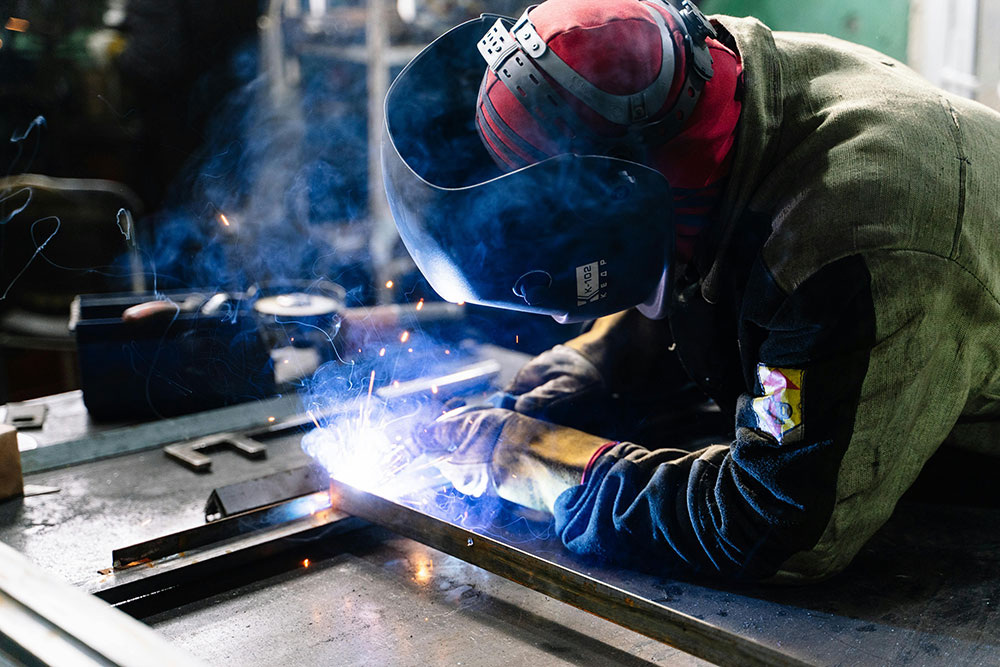
You do not need to understand every technical detail, but you should expect evidence that:
- The welding process has been properly defined
- The procedure has been tested and proven
- The welder is qualified to carry out the work
- Inspection and quality checks are in place
This is particularly important for structural steelwork, pipework, pressure systems, stainless steel fabrication and other safety-critical applications, where fabrication quality assurance plays a direct role in performance and compliance.
What Is ISO 3834?
At its core, ISO 3834 is a quality management framework specifically focused on welding. It defines how welding activities should be planned, controlled and verified to ensure consistent quality.
Rather than being just a certificate to display, ISO 3834 relates to how welding is managed before, during and after fabrication. It demonstrates that a manufacturer has the capability to produce welded products that meet specified quality requirements.
The standard includes different levels of quality requirements – such as comprehensive, standard and elementary – depending on the complexity and risk level of the work being carried out.
What ISO 3834 Helps Control
ISO 3834 provides a structured approach to controlling key aspects of welding, including:
- Welding coordination
- Material control and traceability
- Welding procedures
- Welder competence
- Inspection and testing
- Subcontractor management
- Records and documentation
Why Buyers Should Care About ISO 3834
For buyers, ISO 3834 provides confidence that welding is not left to chance. It shows that the supplier has a controlled system in place, ensuring consistency, traceability and repeatable quality across projects.
What Is a WPS? Welding Procedure Specification Explained
A Welding Procedure Specification (WPS) is the instruction document that tells the welder exactly how a weld should be carried out.
Standards such as ISO 15609-1 define the required content of a WPS for arc welding processes, ensuring that all critical variables influencing weld quality are controlled.
What a WPS Usually Includes
A WPS will typically define:
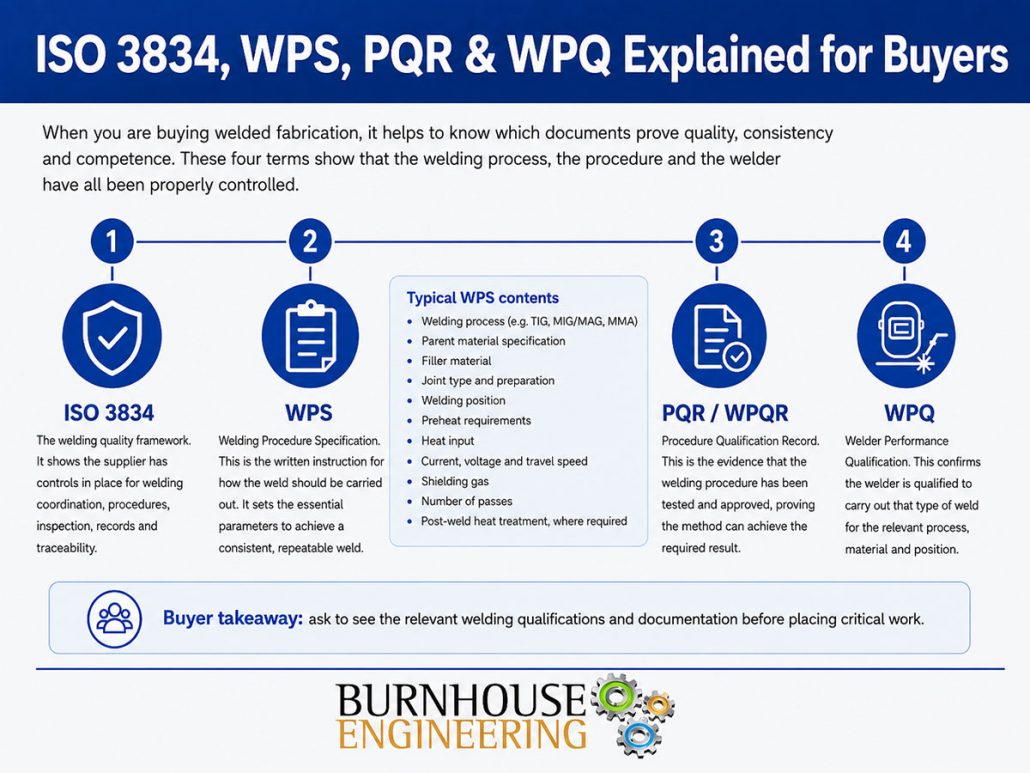
Why a WPS Matters to Buyers
A WPS ensures consistency and control. It means that welding is carried out according to an approved method, rather than relying on individual judgement.
A useful way to think of it is as a controlled recipe for a weld, including setting out the correct materials, parameters and process to achieve the desired result.
What Is a PQR or WPQR?
Buyers may encounter the terms PQR, WPAR or WPQR. While terminology can vary depending on standards, they all refer to the same principle: evidence that a welding procedure has been tested and proven to work.
Industry guidance, including from organisations such as TWI, explains that a WPS must be supported by approval records demonstrating how the weld was produced and how it performed under testing. Under BS EN ISO terminology, this is often referred to as a WPQR (Welding Procedure Qualification Record).
What a PQR/WPQR Proves
A qualified procedure record demonstrates that:
- The welding method has been tested
- The test weld has passed required inspections and tests
- The procedure can produce welds with the necessary mechanical properties
- The procedure is valid across a defined range of materials, thicknesses and positions
Typical Tests Behind a PQR/WPQR
Depending on the applicable standard, testing may include:
- Visual inspection
- Bend testing
- Tensile testing
- Macro examination
- Impact testing
- Hardness testing
- Non-destructive testing (NDT)
Standards such as the ISO 15614 series define how welding procedures are qualified for production and repair work.
What Is WPQ? Welder Performance Qualification Explained
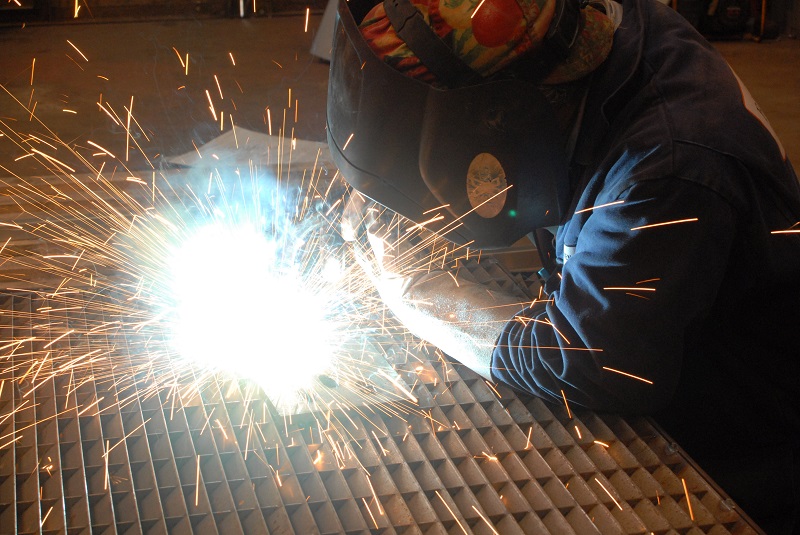
While a PQR proves that a welding procedure works, a WPQ (Welder Performance Qualification) proves that the individual welder can carry out that procedure correctly.
Standards such as ISO 9606 focus on testing a welder’s practical ability to produce welds of acceptable quality under defined conditions.
What WPQ Confirms
A WPQ demonstrates that:
- The welder is capable of producing the required weld
- They are qualified for specific processes, materials, positions and thickness ranges
- Their qualification is valid and maintained in line with applicable standards
Simple Buyer Explanation
A helpful way to distinguish these documents is:
- WPS = how the weld should be done
- PQR/WPQR = proof that the welding method works
- WPQ = proof that the welder can perform the weld correctly
How ISO 3834, WPS, PQR and WPQ Work Together
These elements form a complete system of fabrication quality assurance:
- The supplier operates within a welding quality framework such as ISO 3834
- A WPS defines how each weld should be carried out
- A PQR/WPQR proves that the procedure has been tested and validated
- A WPQ confirms that the welder is qualified to perform the weld
- Inspection and testing verify that the finished weld meets requirements
Why This Reduces Buyer Risk
This structured approach delivers clear benefits:
- Greater consistency across production
- Improved traceability of materials and processes
- Reduced likelihood of defects
- Stronger compliance with project requirements
- Clear and auditable documentation
- Reduced risk of rework or disputes
For buyers, this translates into confidence in both the process and the finished product.
What Should Buyers Ask Their Welding or Fabrication Supplier?
When engaging a supplier, it is reasonable to ask questions that confirm their approach to welding quality:
- Do you work to recognised welding quality standards?
- Can you provide WPS documentation where required?
- Are your welding procedures qualified?
- Are your welders qualified for the required processes and materials?
- What inspection and testing can be carried out?
- Can you supply weld records, material certificates and traceability documentation?
- Do you have experience in similar projects or industries?
- Can you support both workshop and on-site welding requirements?
These questions help ensure alignment early in the project.
When Are These Documents Most Important?
Not every fabrication project requires the same level of documentation. However, certain applications demand a higher level of control and verification, including:
- Structural steelwork
- Pressure pipework and systems
- Process pipework
- Stainless steel systems
- Food, pharmaceutical or hygienic applications
- Offshore, marine and energy-related projects
- Safety-critical platforms, frames and access structures
- Projects requiring third-party inspection
- Work requiring full documented handover
In these cases, welding quality standards and documentation are essential for compliance and long-term performance.
Common Misunderstandings Buyers Have
“A Good-Looking Weld Is Always a Good Weld”
While appearance is important, it does not guarantee internal quality. Factors such as penetration, fusion and material compatibility are critical and often require testing to verify.
“One Welder Qualification Covers Everything”
Welder qualifications are typically limited to specific processes, materials, positions and thickness ranges. A welder qualified in one scenario may not be qualified in another.
“A WPS and PQR Are the Same Thing”
A WPS is the instruction for carrying out the weld, while the PQR/WPQR is the evidence that the procedure has been tested and approved.
“Documentation Is Just Paperwork”
In reality, documentation provides proof that welding has been carried out correctly. It protects both the supplier and the buyer by demonstrating compliance and quality control.
Why Work With a Welding and Fabrication Partner That Understands Compliance?
Working with a supplier who understands welding standards, documentation and inspection processes offers clear advantages.
At Burnhouse Engineering, welding and fabrication are approached as part of a controlled, end-to-end process, supported by experienced teams and recognised procedures. This includes capabilities across:
- TIG, MIG/MAG and orbital welding
- Mobile and on-site welding services
- Structural and stainless steel fabrication
- Engineering design and fabrication support
For buyers, this means working with a partner who can align process, documentation and practical delivery, reducing risk and supporting successful project outcomes.
What Buyers Really Need to Know
ISO 3834, WPS, PQR/WPQR and WPQ all exist to achieve the same goal: to control quality, prove competence and reduce risk in welding.
You do not need to become a welding expert to make informed decisions. What matters is understanding that these systems provide evidence of capability, consistency and compliance.
When a supplier can clearly explain their approach, provide the appropriate documentation, and match the correct welding method to your project, it gives you confidence that the finished work will meet expectations, both in the workshop and on site.